
To future-proof your career against AI, start with a clear picture of which of your tasks are exposed, then apply the mindset shift where it counts.
Argenti's advice to a senior banker was to stop hunting for the 10 percent of the job AI can never touch and instead rebuild toward a new 100 percent built on judgment and supervision. As a mindset, that is sound. As a plan, it is incomplete. Every major research effort measuring AI at work, from OpenAI's GDPval benchmark to Microsoft's analysis of 200,000 real Copilot conversations, measures AI at the level of tasks and work activities rather than job titles or attitudes. If the evidence about AI is task-shaped, your response to it has to be task-shaped too. To future-proof your career against AI, start with a clear picture of which of your tasks are exposed, then apply the mindset shift where it counts.
What did the Goldman Sachs CIO actually argue?
In a June 2026 Harvard Business Review article, Marco Argenti describes a senior banker asking which small slice of his job he should protect because AI will never be able to do it. Argenti's answer was to let that slice go. In his words, the goal is to "resurrect professionally into a new 100%", one built on instincts, judgment, and values rather than on the habits that got you here. He compares it to an experienced horse rider learning to drive: almost none of the riding skills transfer, but the reflexes do.
There is real wisdom here. A permanently safe corner of any job probably does not exist, and clinging to one is a losing strategy. Where the argument thins out is the jump from "no task is permanently safe" to "so stop thinking about your tasks." The evidence he cites points the other way.
Why the evidence behind the mindset argument is built on tasks
To support the claim that AI is advancing quickly, Argenti points to GDPval, OpenAI's benchmark comparing AI agents to human professionals. Look at how GDPval is built. It covers 44 occupations from the top nine industries contributing to U.S. GDP, with 1,320 tasks crafted and vetted by professionals averaging more than 14 years of experience, and it selects those occupations using U.S. Department of Labor data: BLS wage figures and O*NET task analysis. Graders compare AI output to human output task by task, in blinded head-to-head judgments.
So the strongest evidence for "AI is coming for professional work" is a stack of task-by-task comparisons. Nowhere does it make a claim about whole professions. The benchmark cannot tell you whether "investment banker" survives. It can only tell you how AI performs on specific deliverables that make up parts of that job. The unit of change is the task. Every study cited in this article analyzes work at that level.
What does real-world usage data show?
Benchmarks measure what AI can do. Usage data shows what workers actually do with it, and the picture is just as task-shaped.
Microsoft Research analyzed 200,000 anonymized conversations with Bing Copilot and classified each one against the work activities in the O*NET occupational database, the same U.S. Department of Labor data our task-by-task AI exposure report is built on. The most common activities people brought to AI were gathering information and writing. The study also draws a distinction that matters for every worker: what the user was trying to accomplish and what the AI actually performed were often different activities. AI applicability, the researchers found, cuts across sectors because most occupations contain some information work, but it lands unevenly inside each job.
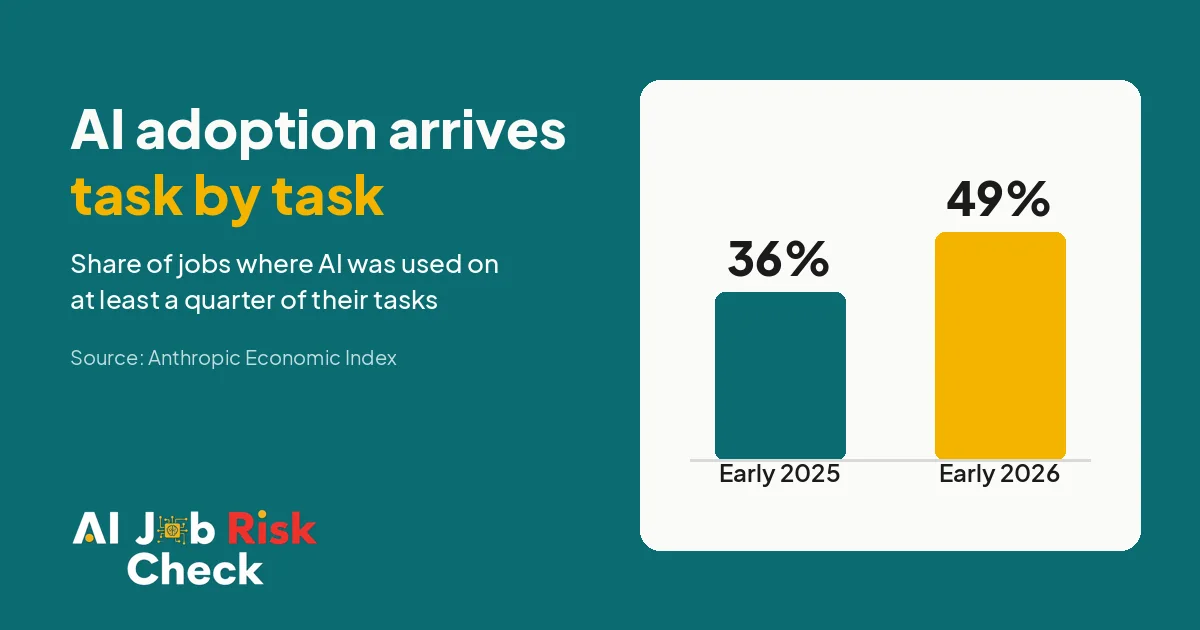
Anthropic's Economic Index, which maps millions of real AI conversations to O*NET tasks, tells the same story from another platform. In its latest reports, about 49 percent of jobs in the sample had seen AI used for at least a quarter of their tasks, up from 36 percent in the first report a year earlier. Adoption is not arriving as whole jobs switching over. It is arriving task by task, a quarter of a job at a time. (In the interest of transparency: our product runs on Anthropic models, and we cite their research here because it is one of the largest open datasets of real AI usage, not because of that relationship.)
Who actually benefits when AI enters a workplace?
This is where the research most directly complicates a pure mindset prescription. The strongest peer-reviewed evidence to date is Brynjolfsson, Li, and Raymond's study published in the Quarterly Journal of Economics in 2025. They tracked the staggered rollout of a generative AI assistant across 5,172 customer-support agents. Productivity rose about 15 percent on average, but the average hides the real finding. Less experienced, lower-skilled workers improved in both speed and quality. The most experienced, highest-skilled workers gained a little speed and lost a little quality.
Notice what happened to the novices. AI did not ask them to let go of their skills and rebuild from scratch; it transferred the tacit task knowledge of top performers to them and moved them down the experience curve faster. For the veterans, the calculus was different: the tool added less and interfered more. Same job title, same company, same AI, opposite experiences. The right move depended entirely on where each worker sat in the task and experience map.
A working paper from the Stanford Digital Economy Lab points the same direction at economy scale. Using ADP payroll records covering millions of workers, Brynjolfsson, Chandar, and Chen find that recent employment declines concentrate among early-career workers in occupations where AI tends to automate tasks, while experienced workers in the same occupations have stayed stable, and roles where AI augments work have held up. The authors are careful to call this evidence correlational rather than causal, and we hold it to the same standard. But the pattern is consistent: what AI does to a career runs through the composition of its tasks, whatever the title on the badge says.
So is it mindset or skillset? It is a map, then a mindset.
Here is how Argenti's argument and the research record fit together.
| Question | Mindset alone answers it? | A task map answers it? |
|---|---|---|
| Should I stop defending my old habits? | Yes | No |
| Which of my tasks is AI already doing well? | No | Yes |
| Where does my judgment still carry the value? | No | Yes |
| What should I learn next, in what order? | No | Yes |
| Will I keep adapting as AI improves? | Yes | No |
Argenti is right that courage, curiosity, and a willingness to let habits die are the traits that carry people through technological change. But courage needs a direction. A medical transcriptionist, a bookkeeper, and a financial analyst who all adopt the same brave mindset still face three completely different sets of exposed tasks, and three different answers to "what do I do Monday morning." Telling all three to embrace a new 100 percent without showing them which parts of their current 100 percent are moving is optimism dressed up as strategy.
That is the gap a task-level diagnostic fills. Our assessment uses time-weighted task analysis built on O*NET occupational data to show you which of your actual tasks carry AI exposure and how much of your week sits in them, using a transparent scoring methodology you can read in full. It takes about 60 seconds to get your free score on the homepage. Your score does not predict job loss. Treat it as a starting point for deciding which skills, tasks, and career options deserve your attention next. The mindset Argenti describes is what you bring to that starting point.
Get your free AI Job Risk Score. Tell us your job title and how you actually spend your time, and we will show you which of your tasks are exposed today. Free. 60 seconds. No sign-up required.
Get MY AI Risk Score NowSources
- Argenti, M. (2026, June 12). To Thrive Alongside AI, Focus on Mindset, Not Skillset. Harvard Business Review.
- Brynjolfsson, E., Li, D., & Raymond, L. (2025). Generative AI at Work. The Quarterly Journal of Economics, 140(2), 889-942.
- Brynjolfsson, E., Chandar, B., & Chen, R. (2025). Canaries in the Coal Mine? Six Facts about the Recent Employment Effects of Artificial Intelligence. Stanford Digital Economy Lab.
- OpenAI (2025). GDPval: Measuring the performance of our models on real-world tasks.
- Tomlinson, K., Jaffe, S., Wang, W., Counts, S., & Suri, S. (2025). Working with AI: Measuring the Applicability of Generative AI to Occupations. Microsoft Research.
- Anthropic (2026). The Anthropic Economic Index.