
The short answer: AI risk is not about job titles disappearing overnight. It is about specific tasks being absorbed inside a role, leaving a different job behind.
Two 2026 sources anchor the picture. Tufts University's American AI Jobs Risk Index, built by the Digital Planet research center at the Fletcher School, maps vulnerability across nearly 800 occupations and finds industry-wide vulnerability averaging about 6 percent, with the steepest exposure in Information (18 percent), Finance and Insurance (16 percent), and Professional, Scientific, and Technical Services (16 percent). Anthropic's Economic Index finds no clear unemployment signal in high-exposure occupations as of early 2026, but does find that hiring of workers aged 22 to 25 into the most exposed roles has slowed by around 14 percent relative to what you would otherwise expect. For now, the data shows tasks eroding and hiring slowing while layoffs remain rare. That leaves a window to act.
The Jobs With the Highest AI Exposure Right Now
Tufts names web and digital interface designers, web developers, database architects, computer programmers, data scientists, and financial risk specialists among the highest-exposure occupations. The table below shows which tasks are actually being absorbed, and which parts of each job still need a person.
| Job | Tasks AI is already doing | What still needs a human |
|---|---|---|
| Computer programmer | Generating boilerplate, writing routine functions, drafting and explaining code | System design, debugging unfamiliar failures, judgment about tradeoffs |
| Web / digital interface designer | Producing layout variations, generating copy and image assets, first-pass mockups | Brand judgment, accessibility calls, stakeholder alignment |
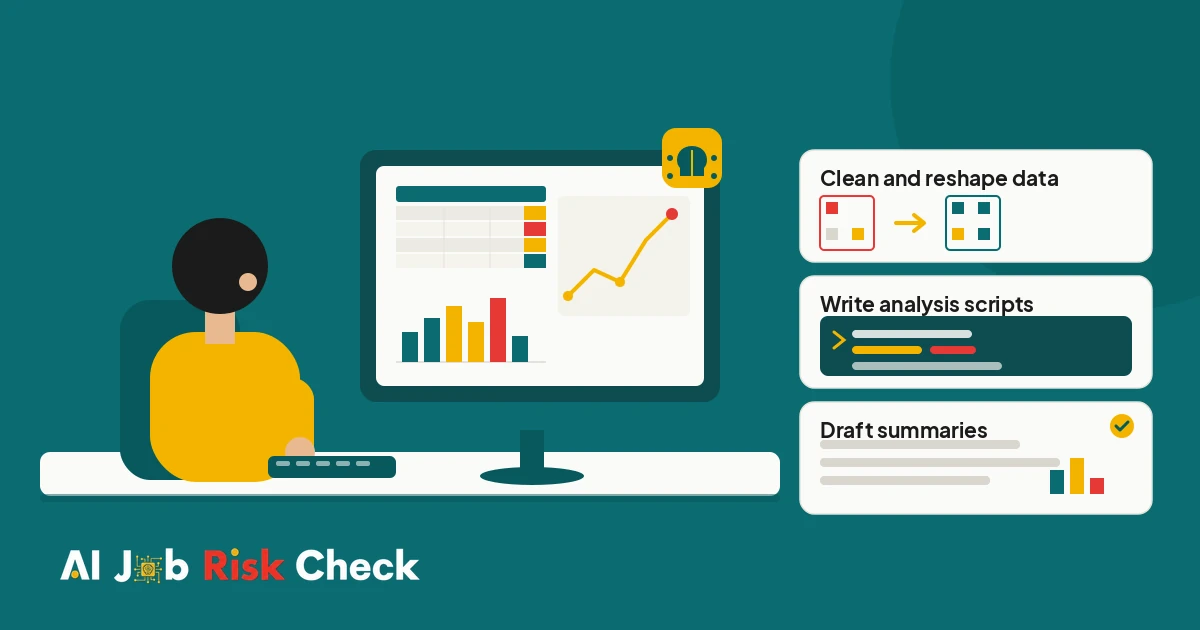
| Data scientist | Cleaning and reshaping data, writing analysis scripts, drafting summaries | Framing the question, validating results, deciding what matters |
| Financial analyst | Building routine models, pulling and formatting figures, drafting commentary | Interpreting findings, advising clients, owning the recommendation |
| Customer service representative | Answering routine and billing questions, drafting replies, triaging tickets | Complex escalations, judgment calls, de-escalating upset customers |
| Writer / author | First drafts, outlines, summaries, formulaic and templated copy | Original reporting, voice, argument, fact ownership |
| Bookkeeper / accounting clerk | Categorizing transactions, reconciling records, generating standard reports | Exceptions, audit judgment, advising on what the numbers mean |
| Market research analyst | Summarizing survey data, drafting reports, pulling comparisons | Study design, interpretation, translating data into a decision |
The common thread is the mix of tasks. A programmer who mostly reviews and integrates other people's work sits in a different place than one who writes greenfield code all day. That is exactly why a single number attached to a job title tells you less than you think.
What Makes a Job High-Risk vs. Low-Risk
Four patterns explain most of the risk.
Repetitive, structured outputs. If the work follows a predictable format, such as standard reports, data summaries, or transcriptions, AI can reproduce it at scale. The more your output looks like a template someone fills in, the more exposed it is.
Language-heavy tasks. Writing, drafting, translating, summarizing, and responding to routine queries are where large language models are strongest today. Roles built mostly on moving text around carry more exposure than roles built on physical presence or judgment.
Predictable, rule-based decisions. When a decision follows a clear set of inputs and rules, such as routine underwriting, credit checks, or standard tax prep, a model can learn the pattern. Decisions that hinge on ambiguity, negotiation, or accountability are harder to hand off.
Document processing. Reading, extracting, and classifying information from documents is one of the most automatable task categories in 2026.
This is the framework behind the score. The peer-reviewed foundation is Eloundou et al. (2024), published in Science, which applied a task-exposure rubric to roughly 19,265 tasks in the U.S. Department of Labor's O*NET database. Their estimate: about 1.8 percent of jobs could have more than half their tasks meaningfully affected by LLMs with simple interfaces, rising to just over 46 percent of jobs once you account for the complementary software being built around those models. In other words, the ceiling on exposure is high, but how much of it reaches your specific day depends on your task mix.
Jobs That Are Surprisingly Safe Right Now
Tufts also finds that about 38 percent of American workers sit in a near "AI-proof" zone, with displacement risk under 1 percent. These are roofers, orderlies, dishwashers, cooks, warehouse workers, childcare workers, plumbers, electricians, and physical therapists. Work that is physical, spatially embedded, or unpredictable in ways current AI handles poorly.
The safest jobs right now are often the lowest-paid ones. The safe zone is largely the near-poverty zone. These roles are protected not because they are prized, but because their work is hard for a model to reach.
There is a second inversion. AI exposure does not fall hardest on economically struggling regions. It concentrates in prosperous, high-tech metros. Silicon Valley leads all regions, and university towns including Durham and Chapel Hill rank among the most exposed metro areas in the country. The places that built the technology are the first to feel it.
Why Your Job Title Isn't the Whole Story
Two people with the same title can have completely different AI exposure, because they spend their time differently.
A software engineer who spends most of the day reviewing and debugging code others wrote faces different exposure than one writing new systems from scratch. A customer service rep who handles complex escalations is less exposed than one answering routine billing questions all day. A financial analyst who builds models from scratch is in a different position than one who mostly interprets results and presents them to clients.
Job titles are too broad to answer the question that matters to you. AI risk lives at the task level. That is what AI Job Risk Check measures.
Get your free AI Job Risk Score. Tell us your job title and how you actually spend your time, and we will show you which of your tasks are exposed today. Free. 60 seconds. No sign-up required.
Get MY AI Risk Score NowFrequently Asked Questions
Will AI replace my job entirely, or just parts of it?
AI absorbs tasks inside roles rather than eliminating titles. Anthropic measures no systematic unemployment rise among exposed workers today, though early-career hiring has slowed. The 9.3 million at-risk figure is a projection for two to five years out.
Which industries are most exposed to AI right now?
Information (about 18 percent vulnerability), Finance and Insurance (about 16 percent), and Professional, Scientific, and Technical Services (about 16 percent), per Tufts. Of the 9.3 million at-risk jobs, roughly 4.9 million sit within 33 higher-risk tipping-point occupations.
How do I find out my personal AI job risk?
Look at your task mix rather than your title. AI Job Risk Check maps your daily tasks to the O*NET database and scores each against current AI capability using the Eloundou et al. (2024) framework. Free, about 60 seconds, no sign-up.
Sources
- Tufts University, Digital Planet at The Fletcher School, American AI Jobs Risk Index (2026). Read the release.
- Anthropic Economic Index (2026). Read the report.
- Eloundou, T., Manning, S., Mishkin, P., and Rock, D. (2024). GPTs are GPTs: Labor Market Impact Potential of LLMs. Science, 384(6702), 1306 to 1308. View in Science.