The Short Answer
If you type dictated medical audio into reports for a living, the most automatable part of your day, straight dictation-to-text, is exactly the part AI does well now. The part that remains human is editing, quality assurance, and handling messy real-world audio. The pivot is to move up that ladder into medical records and health information roles, which BLS projects to grow while transcription shrinks. A risk calculator can show you the exposure, but it will not build your plan.
Why medical transcription is declining
The Bureau of Labor Statistics projects employment of medical transcriptionists to decline about 5% from 2024 to 2034. Its Monthly Labor Review is unusually direct about the cause, stating the decline is because AI technology can recognize speech and transcribe audio, reducing the need for these workers. About 43,900 people held the job in 2024, at a median wage of $37,550. Every projected opening over the decade is a replacement opening, from people retiring or leaving. None come from growth.
It is not the job that is at risk. It is the hours.
A job is a bundle of tasks, and each task takes a different share of your week. Whether AI can touch your job matters less than how much of your week goes to the tasks it can already do.
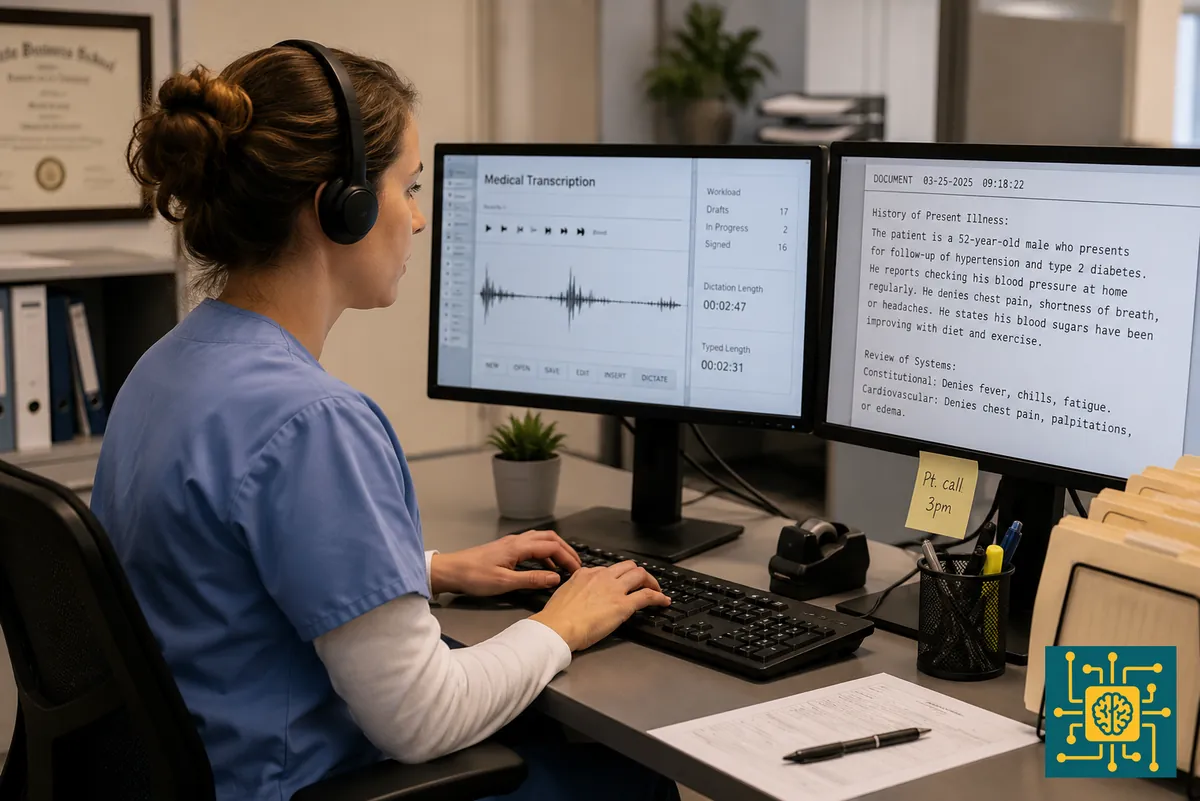
For a transcriptionist, the dominant task is converting clean dictated audio into formatted text. That is precisely the case where AI is strongest. A 2025 systematic review by Ng et al. in BMC Medical Informatics and Decision Making found speech-recognition word error rates as low as about 8.7% in controlled dictation settings. When the audio is clean and one person is speaking, the machine is accurate. So the single biggest block of a transcriptionist's day is the most exposed.
But the same review found error rates climbing above 50% in conversational, multi-speaker settings. A 2024 JAMIA Open study by Zolnoori et al. documented that speech-recognition accuracy varied by patient race, underscoring that automated transcripts still need human review. So the hours spent on hard audio, editing, and quality assurance are far less exposed. The pivot is to move your week toward those hours, and then beyond them.
Where the hours are growing
The same demographic forces shrinking transcription are expanding the roles next to it. As the population ages and records multiply, someone has to validate, code, and manage that data.
| Role | BLS projected growth, 2024 to 2034 | Median wage, May 2024 |
|---|---|---|
| Medical transcriptionist | About -5% | $37,550 |
| Medical records specialist | About +7% | See BLS |
| Health information technologist / medical registrar | About +15% | $67,310 |
| Medical and health services manager | About +23% | $117,960 |
Every role below transcription in that table grows, and every one reuses the medical vocabulary and documentation judgment you already have. Those growth rates belong to the pivot occupations, not to transcription, where every projected opening only replaces someone who left. A transcriptionist knows medical terminology, formatting standards, and what a correct record looks like. That is the exact foundation a records or health-information role is built on.
What a "will AI take my job calculator" does, and where it stops
A good calculator is a useful first step. It can show you which of your tasks are exposed and roughly how much of your time sits in the danger zone.
But a score is only a diagnosis. The treatment plan is a separate piece of work. Knowing you are at 70% exposure tells you that you should move. It does not tell you where to move, which credential to earn first, how to reframe your transcription experience for a records role, or what to do in the ninety days after you read the number. The gap between knowing your risk and acting on it is where careers stall. The harder and more valuable work is the plan, and the follow-through on it.
Get your free AI Job Risk Score. Tell us your job title and how you actually spend your time, and we will show you which of your tasks are exposed today. Free. 60 seconds. No sign-up required.
Get MY AI Risk Score NowFrequently Asked Questions
Is a "will AI take my job calculator" accurate?
Only at the task level. A calculator built on task data can estimate which tasks AI can do, but it cannot see your employer, local market, or willingness to retrain. Check that any tool names its data sources.
Where does AI transcription still fail?
On hard audio. Error rates climb above 50% with multiple speakers, and Zolnoori et al. (2024) found accuracy varied by patient race. That is why speech-recognition editing and quality assurance are still hired as human roles.
Should I wait to see if my job survives?
No. Pivot while you are still employed. A concrete next step is working toward AHIMA's Registered Health Information Technician (RHIT) credential, which maps transcription experience onto the records roles BLS projects to grow.
Sources
- U.S. Bureau of Labor Statistics, Occupational Outlook Handbook, Medical Transcriptionists. View source.
- U.S. Bureau of Labor Statistics, Monthly Labor Review, Industry and occupational employment projections, 2024-34. View source.
- U.S. Bureau of Labor Statistics, Occupational Outlook Handbook, Medical Records Specialists. View source.
- U.S. Bureau of Labor Statistics, Occupational Outlook Handbook, Health Information Technologists and Medical Registrars. View source.
- U.S. Bureau of Labor Statistics, Occupational Outlook Handbook, Medical and Health Services Managers. View source.
- Ng, J.J.W., et al. (2025). Evaluating the performance of artificial intelligence-based speech recognition for clinical documentation: a systematic review. BMC Medical Informatics and Decision Making. View source.
- Zolnoori, M., et al. (2024). Decoding disparities: evaluating automatic speech recognition system performance in transcribing Black and White patient verbal communication with nurses in home healthcare. JAMIA Open. View source.